
This is a winter skincare routine for skin that feels tight by lunchtime and flakes by Friday: five changes that take about ten minutes to set up and then run themselves until spring. You’ll get what to change about your shower, which cleanser and moisturizer to swap, how to keep a retinoid going without your face peeling, and the two things most people drop in November and shouldn’t. At the end there’s a FAQ on humidifiers, lip balm, hands that crack, and how to tell ordinary winter dryness from something that needs a doctor.
One honest warning before we start: your skin probably hasn’t changed. The air has. Indoor heating dries a room out, hot showers strip the surface, and the routine that was perfect in July is now slightly wrong for the conditions. That’s good news, because it means the fix is mostly environmental and takes effect in days rather than months. It also means no product will hold if the shower stays at the same temperature.
Why skin gets worse when the heating goes on
Skin keeps water in through a surface layer of cells and lipids. Cold outdoor air holds less moisture, heated indoor air holds less still, and the difference pulls water out of that layer faster than usual. Add a hot shower, which dissolves some of the oils holding it together, and you get the familiar winter sequence: tight after washing, flaky by the afternoon, and stinging when you put on the product that was fine a month ago.
The fixes with the best support are unglamorous. The American Academy of Dermatology’s advice for dry skin is to limit showers and baths to five to ten minutes in warm rather than hot water, to use a gentle fragrance-free cleanser, and to moisturize several times a day, especially while the skin is still damp. The same page is specific about texture: creams and ointments are more effective than lotions. It also recommends a humidifier in the bedroom overnight, and gloves in cold weather or whenever your hands are in water.
Notice what’s missing from that list. There’s no mention of a new serum, an expensive cream or a ten-step routine. The evidence-backed winter advice is about water, time and texture, which is why this post spends its first two steps on things you already do rather than things you’d have to buy.
A quick word on the numbers in this post. The five-to-ten-minute shower, the damp-skin timing and the cream-over-lotion preference come from the AAD page linked above. The frequencies I suggest for retinoids are practical starting points rather than study findings, because how much a given person tolerates in January varies enormously. If your skin is cracked, bleeding, painfully itchy or weeping, that’s past the scope of a routine and worth showing to a doctor rather than treating with a richer cream.
The winter skincare routine at a glance
| Change | Why it matters | When you’ll notice |
|---|---|---|
| Shorter, cooler showers | Stops stripping the surface faster than you can repair it | Two or three days |
| A creamier cleanser | Removes the day without taking the oils with it | Within a week |
| A thicker moisturizer, on damp skin | The single biggest comfort change | Immediately, then better |
| Less frequent retinoid | Keeps the one active that does something, without the peeling | A week or two |
| Sunscreen, hands and lips | The three things people quietly drop in winter | Long term |
Only two of these cost money, and one of those is a cleanser you were going to replace anyway. Start with the first three; the last two are maintenance you’re already most of the way to doing.
Change the shower before you change the products
This is the step people skip because it isn’t a purchase, and it’s the one with the most immediate effect. A long hot shower in January feels wonderful and undoes a good part of what the rest of your routine is trying to do.
How to do it
- Warm, not hot. If your skin is pink when you get out, the water was too hot.
- Keep it to five to ten minutes. Use a timer for the first week if that sounds impossible; most people are surprised by how long they take.
- Use cleanser only where you need it rather than over the whole body.
- Pat dry instead of rubbing, and leave the skin slightly damp.
- Moisturize within a couple of minutes, while it’s still damp. This is the timing that does the work.
What to change first
| If this is you | Change this |
|---|---|
| Long hot showers in the evening | Temperature first, then length |
| Tight skin straight after washing | The cleanser, and moisturize while damp |
| Flaky shins and forearms | Cleanse only where needed; body cream on damp skin |
The two-minute rule: the window where damp skin takes up a moisturizer best is short. Keep the body cream where you dry off, not in a cupboard in another room, because the step you have to walk for is the step you skip in February.
Swap the foaming cleanser for a creamier one
A cleanser that was pleasantly brisk in August is often the thing making your face tight in December. The giveaway is the squeaky feeling, which people read as clean and skin reads as stripped.
How to do it
- Move from a foaming or gel cleanser to a cream, milk or balm formula for the cold months.
- Choose fragrance-free. Fragrance is the most common irritant in a routine and winter skin is less forgiving of it.
- Wash properly at night and use plain water in the morning unless your skin is oily.
- Don’t use a toner that lists alcohol high in the ingredients, and skip scrubs entirely until spring.
Matching the cleanser to the month
| Skin in winter | Cleanser to use |
|---|---|
| Comfortable, slightly oily | A gentle gel is fine; just lower the water temperature |
| Tight after washing | Cream or milk cleanser, night only |
| Flaking around the nose | Balm cleanser, and pause exfoliating acids |
What squeaky actually means: you’ve removed more than the dirt. A good winter cleanser leaves the skin feeling soft and slightly cushioned, not polished. If yours doesn’t, no amount of moisturizer afterwards fully makes up for it.
Go thicker on the moisturizer, and put it on damp skin
If you only change one product, change this one. The AAD’s wording is blunt: creams and ointments are more effective than lotions. A winter moisturizer should feel noticeably more substantial than your summer one, and it should go on while your skin is still slightly wet.
How to do it
- Switch from a lotion or gel to a cream, and from a cream to a richer cream or an ointment on the driest areas.
- Apply within two minutes of washing, morning and night, while the skin is damp.
- Look for all three kinds of ingredient rather than just one: a humectant that draws water in, an emollient that smooths, and an occlusive that slows water escaping.
- Reapply during the day wherever skin feels tight. Hands after every wash, no exceptions.
- On the driest nights, a thin layer of an ointment over the cream on cheeks or around the nose holds everything in.
What the three ingredient types look like
| Type | Job | Common examples |
|---|---|---|
| Humectant | Pulls water into the surface | Glycerin, hyaluronic acid, urea |
| Emollient | Fills the gaps, smooths the feel | Squalane, ceramides, plant oils |
| Occlusive | Slows water leaving | Petrolatum, dimethicone, shea butter |
The mistake worth avoiding: a humectant alone on very dry skin in very dry air can make things feel worse, because it has nothing to hold the water in once it’s drawn up. That’s why the hyaluronic acid serum that felt amazing in September can feel tight in January unless you put a cream over it.

Keep the retinoid, just use it less often
Winter is when most people quit their retinoid, and it’s an avoidable loss, because it’s the one product in the routine with real evidence behind it. The answer isn’t to stop; it’s to lower the frequency until your skin is comfortable again, and to buffer it.
How to do it
- Cut back by one night. If you were on every other night, go to twice a week for a few weeks.
- Buffer it: moisturizer first, retinoid on top, moisturizer again. It still works, and it stings far less.
- Use a pea-sized amount for the whole face. Winter is not the moment to be generous.
- Pause exfoliating acids while you’re adjusting. Two actives plus dry air is the usual recipe for a peeling face.
- Go back up in spring rather than pushing through now.
If your face is already peeling
| State | What to do |
|---|---|
| Mild flaking | Drop to twice a week and buffer |
| Red, sore, tight | Pause for a week, moisturize only, then restart once a week |
| Fine after two weeks | Add a night back, one at a time |
What not to do: don’t exfoliate the flakes off. It’s the most tempting move and it restarts the cycle, because the flaking is a sign the surface is already compromised. If you want the full starter plan, it’s in my skin care routine for your 30s.
The three things people drop in winter
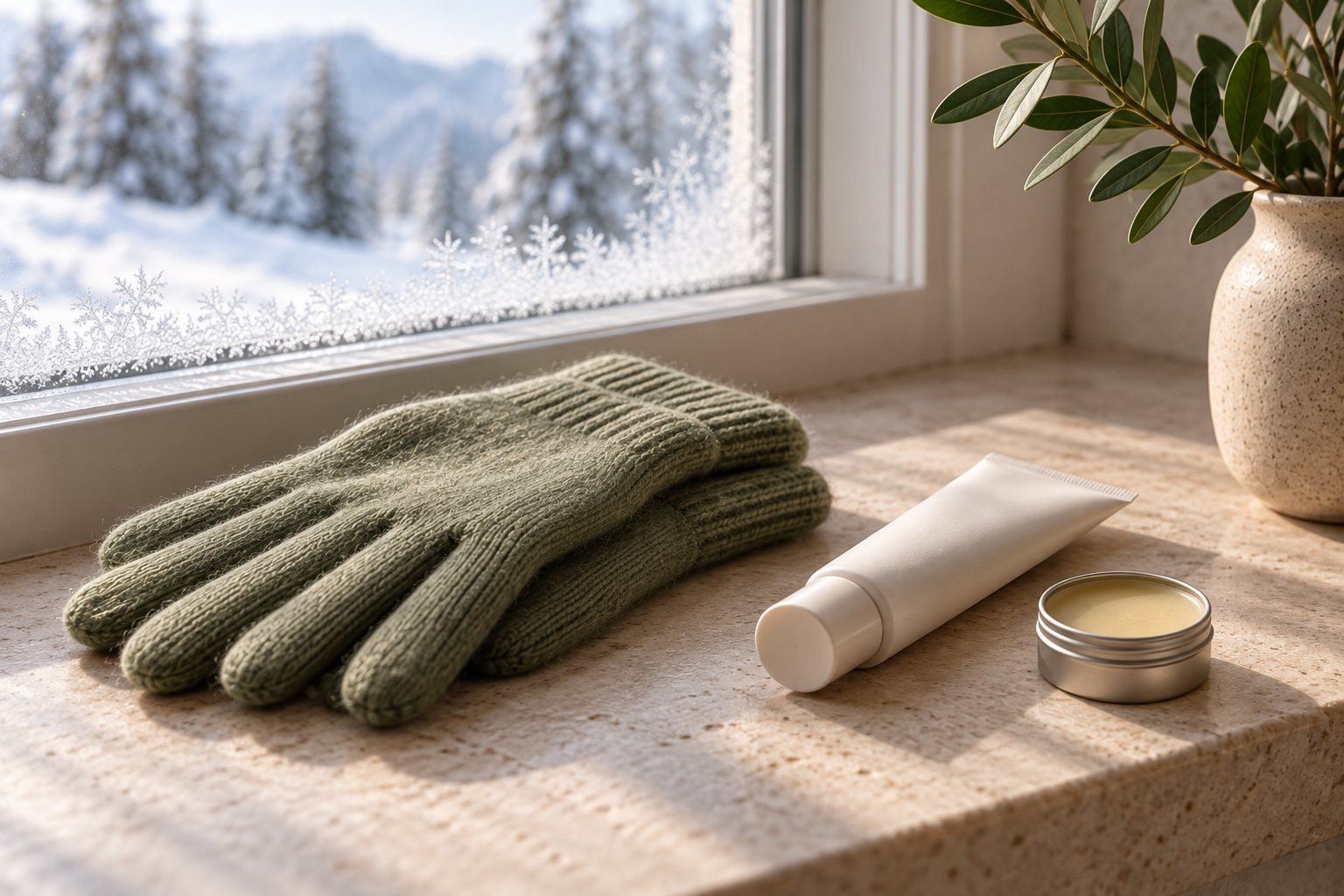
Sunscreen, hands and lips. All three get quietly abandoned around November, and all three are easier to maintain than to repair.
How to do it
- Keep the morning sunscreen. The FDA requires sunscreens that are not broad spectrum, or are below SPF 15, to state that they only help prevent sunburn, which is the quickest way to read a label in a shop. The AAD’s recommendation doesn’t have a season attached to it: broad spectrum, SPF 30 or higher, water resistant, and about a teaspoon for the face. Snow and bright winter days are not an exception.
- Hand cream after every wash, and gloves outside. The AAD specifically recommends gloves in cold weather and whenever your hands are in water.
- A plain ointment lip balm, reapplied often. Stop licking them, which is what turns dry lips into cracked ones.
- Keep a tube in the places where the problem happens: the kitchen sink, your bag, the desk.
Why winter sunscreen still counts
| Claim | Reality |
|---|---|
| “There’s no sun in January” | UVA is present year-round and passes through cloud and window glass |
| “I’m indoors all day” | True for many people; the commute and the window seat are the exceptions |
| “SPF in my moisturizer is enough” | Only if you use a full teaspoon of it, which almost nobody does |
The honest version: if you genuinely never see daylight on a winter weekday, the stakes are lower, and I’d rather you kept the moisturizer habit than dropped everything because the sunscreen felt pointless. On the days you are outside — the weekend walk, the ski trip, the drive — it matters as much as it does in June.
If the winter version keeps slipping, treat it as a habit problem rather than a willpower one. Pick the single change that bothers you most — usually the shower temperature — and attach it to something that already happens, the way I would set up any reset that has to survive February. One change that holds until March beats five that last a fortnight, and this is a routine you only have to set up once a year.
When it’s more than dry skin
A winter routine handles dryness. It doesn’t handle skin conditions, and the line between them is worth knowing. Skin that is intensely itchy, red and inflamed in patches, cracked to the point of bleeding, weeping, or getting worse despite two weeks of consistent moisturizing has crossed out of routine territory. Eczema, seborrheic dermatitis and a few other conditions flare in winter and respond to treatment that no cream on a shop shelf contains.
The same goes for a sudden change. Dryness that arrives with the heating is ordinary. Dryness that arrives on its own, in one area, or alongside other symptoms, is worth a conversation with a doctor rather than another product.
Questions people ask about a winter skincare routine
Does a humidifier actually help?
The AAD recommends one, and in a heated bedroom it’s a reasonable addition. Put a portable unit in the room where you sleep and run it overnight, and clean it regularly so it doesn’t grow mold. It won’t replace the moisturizer, but it makes the air less hostile for a third of the day.
Can I just use a body cream on my face?
Often yes, if it’s fragrance-free and doesn’t break you out. Facial skin is thinner and more reactive, so patch test it for a few days first. The reverse is always fine: face cream works on the body, it’s just expensive.
Why do my hands crack when the rest of me is fine?
Because they’re washed more often than anything else and spend the most time in cold air. Cream after every wash and gloves outdoors fix most of it. An ointment overnight under cotton gloves fixes the rest.
Should I stop using vitamin C in winter?
No need. It’s rarely the cause of winter irritation; the usual culprits are the cleanser, the water temperature and too much retinoid. Change those first and keep the thing that isn’t causing the problem.
Is petroleum jelly bad for skin?
No. It’s one of the most effective occlusives there is, and the AAD lists ointments as more effective than lotions for dry skin. It sits on the surface rather than absorbing, which is exactly the job. Use it over a moisturizer, not instead of one.
How long until my skin feels normal again?
Shorter showers and a thicker moisturizer usually show within two or three days. A properly compromised surface takes a couple of weeks of consistency. If there’s no improvement at all after two weeks, that’s the signal to stop experimenting and ask a professional.
Cooler showers, a creamier cleanser, a thicker moisturizer on damp skin, a gentler retinoid schedule, and the sunscreen you were already using. That’s the whole winter skincare routine, and four of the five are adjustments rather than purchases. Set it up this week and it will quietly carry you to March, which is roughly when you’ll want to start putting it all back the other way.