
This post is about winter sleep: why the same bedtime that worked in July leaves you groggy in January, and what to change about light, temperature, timing and the evening so the dark months cost you less. You’ll get five adjustments in the order I’d make them, what the body clock is actually doing when the mornings are black, and a FAQ on lie-ins, lamps, naps and when low winter mood is more than a seasonal grumble.
One honest warning before we start: this is a post about ordinary seasonal tiredness, not about a diagnosable condition. If your low mood and low energy return every winter and interfere with work, relationships or daily life, that pattern has a name and treatments that work, and it belongs in a doctor’s office rather than in a blog post. Nothing here is a substitute for that conversation.
Why winter sleep feels worse even when it’s longer
The main suspect is light, because light is what the body clock runs on. The master clock in the brain — a cluster of cells called the suprachiasmatic nucleus — keeps the body’s 24-hour rhythms in sync, and light and dark have the biggest influence on it. The same clock controls melatonin production based on the light your eyes receive, signalling the brain to make more of it in the evening.
Now take that system and give it a January in a northern country. You wake in the dark, commute in the dark, spend the day under indoor lighting that is a small fraction of outdoor brightness even on a grey day, and come home in the dark. The signal that tells your clock when the day starts is weak, late, or both. Everything downstream — when you feel alert, when you feel sleepy, how easily you get up — drifts with it.
Two smaller factors pile on. Bedrooms get warmer because the heating is on, which works against the drop in body temperature that normally accompanies falling asleep. And the social calendar in December does what it does: later nights, more alcohol, more irregular timing in the four weeks when the light signal is already at its weakest.
A quick word on the numbers in this post. The circadian mechanism and the melatonin description come from the NIH source linked above, and the sleep-hours figures from the CDC. The specific timings I suggest — how long to get outside, how early to start winding down — are practical starting points rather than trial results. People differ enormously in how much the dark months affect them, and the right answer for you is the one you can test over a couple of weeks.
What to change for winter sleep, at a glance
| Change | What it targets | How long to give it |
|---|---|---|
| Morning light, first thing | The weak start-of-day signal | One to two weeks |
| Hold the wake-up time | Drift caused by dark mornings | Two weeks |
| Turn the bedroom down | A heated room working against sleep | Two or three nights |
| Dim the evening | Late light pushing the clock later | A week |
| Protect December | The month that undoes the other four | The month itself |
None of these need equipment, and the first two carry most of the effect. If you only do one thing, get outside in the morning.
Get light into the morning, however you can
In summer this happens by accident. In winter it has to be deliberate, because the gap between waking and seeing real daylight can stretch to hours, and that gap is where the problem starts.
How to do it
- Get outside within an hour or so of waking, even for ten minutes. Overcast winter daylight is still far brighter than any room.
- If it’s dark when you wake, go out at the first opportunity — the walk to the car, the first break, the school run.
- Open the curtains the moment you’re up, and work near the window when you can.
- Don’t save the outdoor time for the evening. It’s pleasant, but it does nothing for the morning signal.
- Do it every day, including weekends. Consistency is what the clock responds to.
If the mornings are genuinely black
| Situation | What helps |
|---|---|
| Dark at wake-up, light by nine | Push the outdoor ten minutes to the first light you get |
| Office all day | A lunchtime walk outside, not a bright room |
| Shift work | Different problem; worth professional advice |
| Considering a light box | Reasonable to ask a doctor about rather than guess |
What “bright” actually means: a well-lit office is dramatically dimmer than an overcast winter day outside. That’s why stepping out of the door for ten minutes beats an hour under good indoor lighting, and why the window seat is a consolation prize rather than a solution.
Hold your wake-up time, especially on Sunday
Dark mornings make the alarm negotiable in a way that light ones don’t, and a wake-up time that slides by an hour or two at weekends is the fastest way to feel permanently jet-lagged in February.
How to do it
- Pick a wake-up time you can keep seven days a week, including the one you’d rather not.
- Let bedtime float a little instead. The wake-up time is the anchor; the other end has more give.
- If you need more sleep, go to bed earlier rather than getting up later.
- Cap the weekend lie-in at an hour. Beyond that you’re moving your clock and paying for it on Monday.
- Pair getting up with the light step above. The two together are much stronger than either alone.
How much sleep to aim for
| Age | CDC recommendation |
|---|---|
| 18 to 60 | 7 or more hours a night |
| 61 to 64 | 7 to 9 hours |
| 65 and older | 7 to 8 hours |
Those are the CDC’s figures, and they don’t change with the season. The temptation in winter is to assume you need more because it’s dark, when what most people actually need is the same amount, taken more regularly.
Turn the bedroom down, even though it’s cold outside
This one feels wrong in January and it’s the change people notice fastest. Falling asleep involves a drop in core body temperature, and a bedroom at the same temperature as the living room makes that harder, not cosier.
How to do it
- Turn the bedroom radiator down or off well before bedtime, and let the room cool while you wind down.
- Air the room for a few minutes in the evening, even in winter. Stale warm air is the worst combination.
- Layer the bed instead of heating the room: a cooler room with a warmer duvet beats the reverse.
- Keep your feet warm. Socks in a cool room is a very old trick and a surprisingly effective one.
- If you use electric heating overnight, try turning it off and adding a layer instead for three nights and compare.
The winter bedroom checklist
| Element | What to aim for |
|---|---|
| Temperature | Cooler than the rest of the house |
| Air | Aired in the evening, not sealed all day |
| Bedding | Warm enough that the cool room is pleasant |
| Light | As dark as you can make it, plus curtains that open easily |
The humidity note: heated air is dry air, and a dry throat at four in the morning wakes people more often than they realise. If you already run a humidifier for your skin in winter, the bedroom is the right room for it.
Dim the evening instead of lighting it like noon
If morning light sets the clock forward, bright light late in the evening pushes it back. In winter that matters more, because the contrast between a dark day and a brightly lit evening is exactly backwards from what the system expects.
How to do it
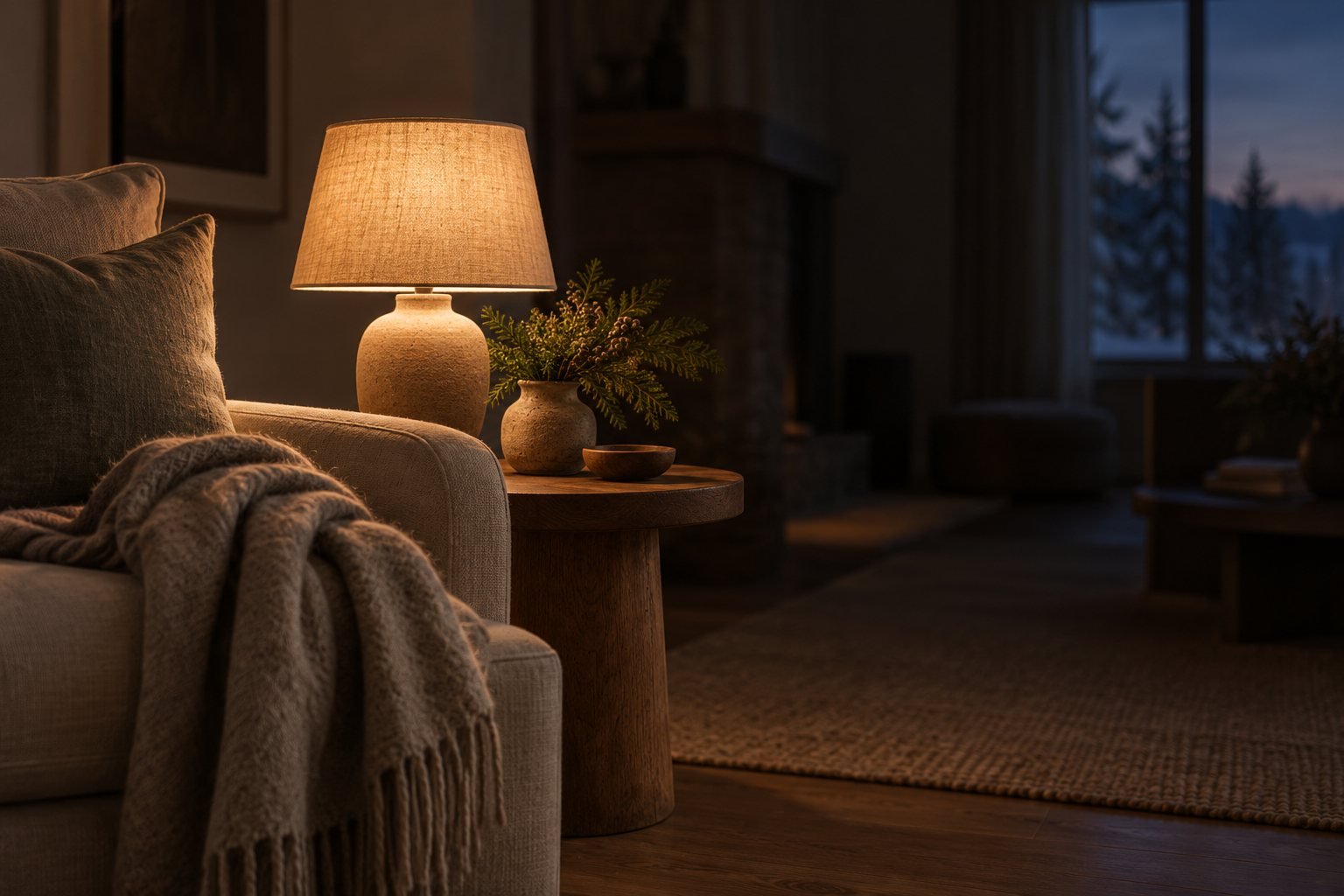
- Drop the overhead lights an hour or two before bed and use lamps instead.
- Warm bulbs in the rooms you use at night. Cool white belongs in the kitchen at eight in the morning.
- Get screens out of the last stretch before bed, or at least off your face.
- Keep the bathroom light dim for the last trip, which is the one people forget.
- Make the bedroom genuinely dark: standby lights, streetlight gaps, the charging phone.
Evening light, ranked
| Source | Effect late at night |
|---|---|
| Overhead white light | The worst of the usual offenders |
| Phone held close to the face | Small source, very close, still counts |
| A low warm lamp | Fine, and the one to default to |
| Candlelight or a dim hallway | Fine |
If you want the full version: the five-step wind-down I use year round is in my evening routine for better sleep, and the winter adjustment is mostly just doing it in dimmer light.
Protect December from itself
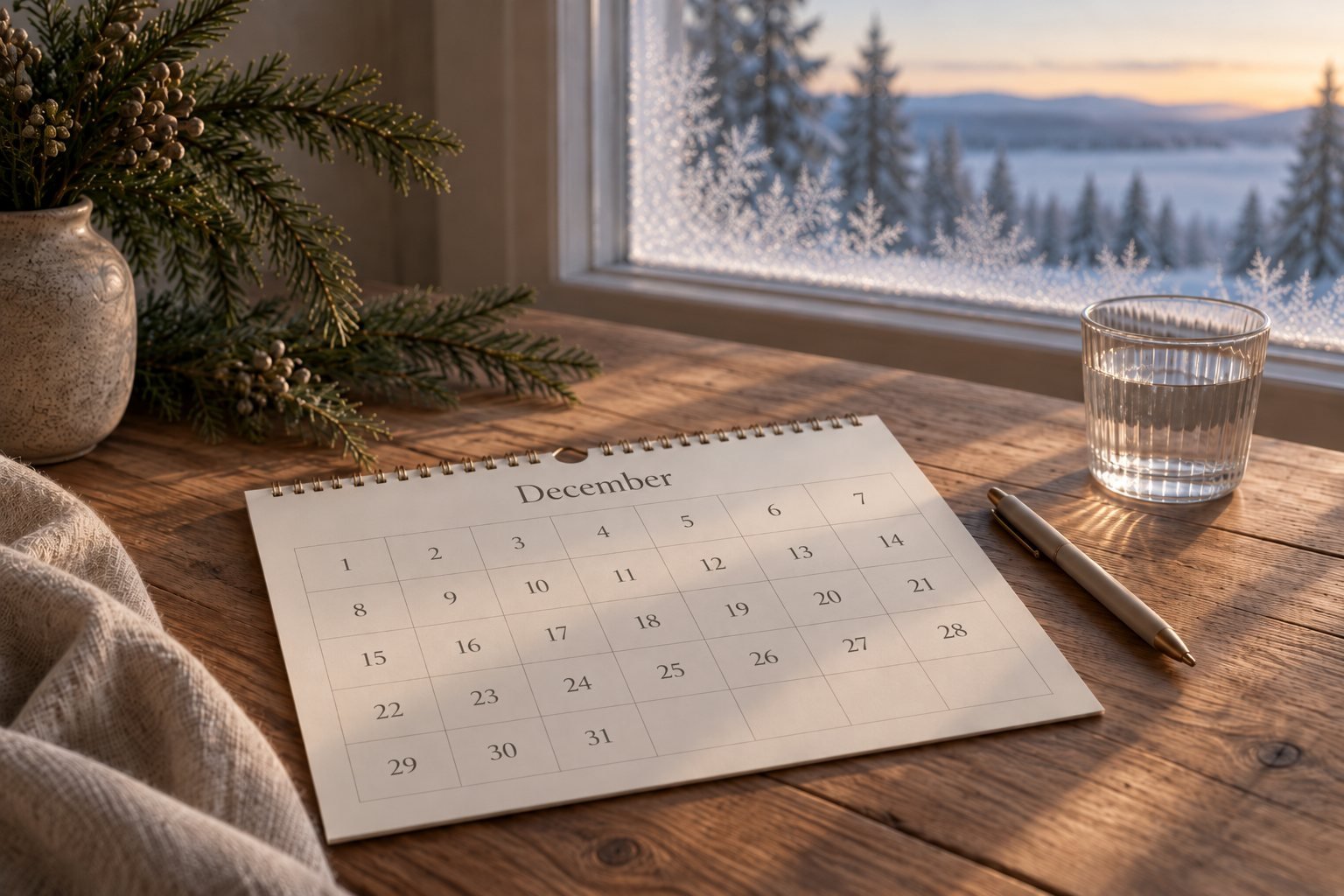
Four weeks of late nights, rich food, alcohol and irregular timing land in the darkest part of the year, which is why January so often feels worse than December did. You don’t have to decline the season to limit the damage.
How to do it
- Pick the nights that matter and let the others be ordinary. Three late nights in a month is very different from twelve.
- Keep the wake-up time even after a late one. It’s unpleasant once; moving it costs you a week.
- Treat alcohol as the sleep variable it is — it gets you to sleep faster and makes the second half of the night worse.
- Keep the morning light step going through the holidays. It’s the one that holds everything else together.
- Don’t try to run a perfect routine in late December. Run a reduced one you’ll actually keep.
What survives a busy December
| Keep | Let go |
|---|---|
| Wake-up time | Bedtime precision |
| Morning daylight | The full wind-down routine |
| A cool bedroom | Tracking anything |
| One or two nights out, chosen | Saying yes to everything |
The January version of this: if you want to rebuild properly once the season is over, do it as one change rather than five, which is the whole argument of my post on a January reset.
What about alcohol, the December variable
It deserves its own paragraph because it’s the single biggest thing that changes about most people’s evenings between November and January, and because its effect on sleep is the opposite of what it feels like. A drink makes falling asleep easier and the second half of the night worse: lighter, more broken, with more waking in the small hours. That’s why a long sleep after a party so often leaves you flat the next day.
You don’t need a rule about abstaining. What helps is spacing: finishing earlier in the evening rather than right before bed, a glass of water alongside, and treating two or three nights a month as the occasions rather than the default. The same logic applies to the lit screen in bed, which in a laboratory study delayed sleep and reduced evening sleepiness compared with reading a printed book — both are evening inputs that feel harmless and land in the part of the night you can’t see.
When winter tiredness is something else
There’s a line between seasonal sluggishness and a condition worth treating. Low mood that arrives every autumn and lifts every spring, sleeping far more than usual without feeling rested, losing interest in things you normally enjoy, or struggling to function at work or at home — that pattern is recognised, common, and treatable, and it responds to approaches that a blog post can’t provide.
The same goes for sleep that is broken rather than merely late: regular waking at the same time every night, loud snoring with daytime exhaustion, or falling asleep during the day no matter what you change. Those are questions for a doctor, not for a darker bedroom.
Questions people ask about winter sleep
Do I actually need more sleep in winter?
Most people need the same amount — the CDC’s seven or more hours for adults doesn’t have a seasonal version. What changes is how hard it is to get it at consistent times, which is a timing problem rather than a quantity one.
Are light boxes worth it?
For some people they help a great deal, particularly where the mornings are genuinely dark for months. It’s also the kind of thing worth asking a doctor about rather than buying on a whim, because the timing and the duration matter and because the symptoms it’s usually bought for deserve a proper look.
Why do I wake up at 3am more in winter?
Common culprits are a bedroom that’s too warm, dry heated air, alcohol earlier in the evening, and an earlier bedtime that shifts the whole night forward. Work through those before assuming it’s the season itself.
Is it bad to sleep in at weekends?
An extra hour is fine. Two or three effectively moves your clock to a different time zone and then moves it back on Monday morning, which is why Sunday nights are so often the worst sleep of the week.
Does exercise help?
Yes, and in winter the best version is outdoors in the morning, because it gives you the movement and the light in the same ten minutes. Late evening exercise suits some people and keeps others awake; test it rather than assuming.
What about napping on dark afternoons?
Short and early is the rule: fifteen to twenty minutes, before mid-afternoon. A long nap at four in the dark is the quickest way to find yourself wide awake at midnight.
Light in the morning, a wake-up time you hold, a cooler bedroom, a dimmer evening, and a December you plan rather than endure. Winter sleep is mostly a timing problem dressed up as a tiredness problem, and the fixes are free. Start with the ten minutes outside tomorrow morning — it’s the one that makes the other four easier.