

This post is about how to fall asleep faster, by which I mean shortening the gap between lights out and actually being asleep. You’ll get five things to change, in order of how well supported they are, what to do with a head that won’t stop, the one rule about lying awake that most people get backwards, and a FAQ on breathing techniques, clock-watching, podcasts and when a persistent problem needs a doctor instead of a tip.
One honest warning before we start: taking twenty minutes to fall asleep is normal, not a problem. If you’re measuring yourself against the people who claim to be out in ninety seconds, you’re comparing yourself to an anecdote. And trying harder makes this worse in a way that’s almost unique among health problems — effort is the opposite of what the system needs. Most of what follows is about removing obstacles rather than adding techniques.
Why you can’t fall asleep, in order of likelihood
Four causes account for most cases, and they’re worth ranking because the fixes differ completely. The first is timing: you’re in bed before your body is ready, often because a poor night made you go up early to catch up. The second is something still circulating — caffeine, alcohol, a late heavy meal, a late workout. The third is light and temperature, the two environmental signals the system reads most strongly. The fourth is a busy head, which is real but which comes last on this list more often than people expect.
The caffeine piece has a number attached to it that surprises people. In a controlled study, 400 mg of caffeine taken even six hours before bedtime reduced total sleep time compared with placebo. Six hours is the measured effect, not the safe margin, which is why a mid-afternoon coffee can quietly be the whole explanation.
Light comes a close second. In a laboratory study, people who read on a light-emitting device before bed took longer to fall asleep, felt less sleepy in the evening, released less melatonin and were less alert the next morning than when they read a printed book. That’s the mechanism behind the advice everyone has heard and most people ignore.
A quick word on the numbers in this post. The caffeine and screen findings come from the two studies linked above, and the sleep-duration figures from the CDC. The timings in the steps — how long to wind down, when to get out of bed — are conventional practical advice rather than trial results. If you regularly lie awake for an hour or more, or you’re exhausted during the day despite enough time in bed, that’s worth taking to a doctor; there are treatments for persistent insomnia that work far better than tips.
How to fall asleep faster, at a glance
| Change | What it fixes | Evidence behind it |
|---|---|---|
| Go to bed later, not earlier | Lying awake because you’re not tired yet | Standard clinical advice |
| Caffeine cutoff | The stimulant still circulating | Controlled study |
| Dim and cool the last hour | Light and temperature signals | Good |
| A warm shower 1–2 hours before | The temperature drop that follows it | Meta-analysis, modest |
| Get out of bed if you’re awake | The bed becoming a place you lie awake | Standard clinical advice |
The first and the last are the ones people resist most and the ones that change the most. Both are counterintuitive, and both work by making the bed a place where sleep reliably happens.
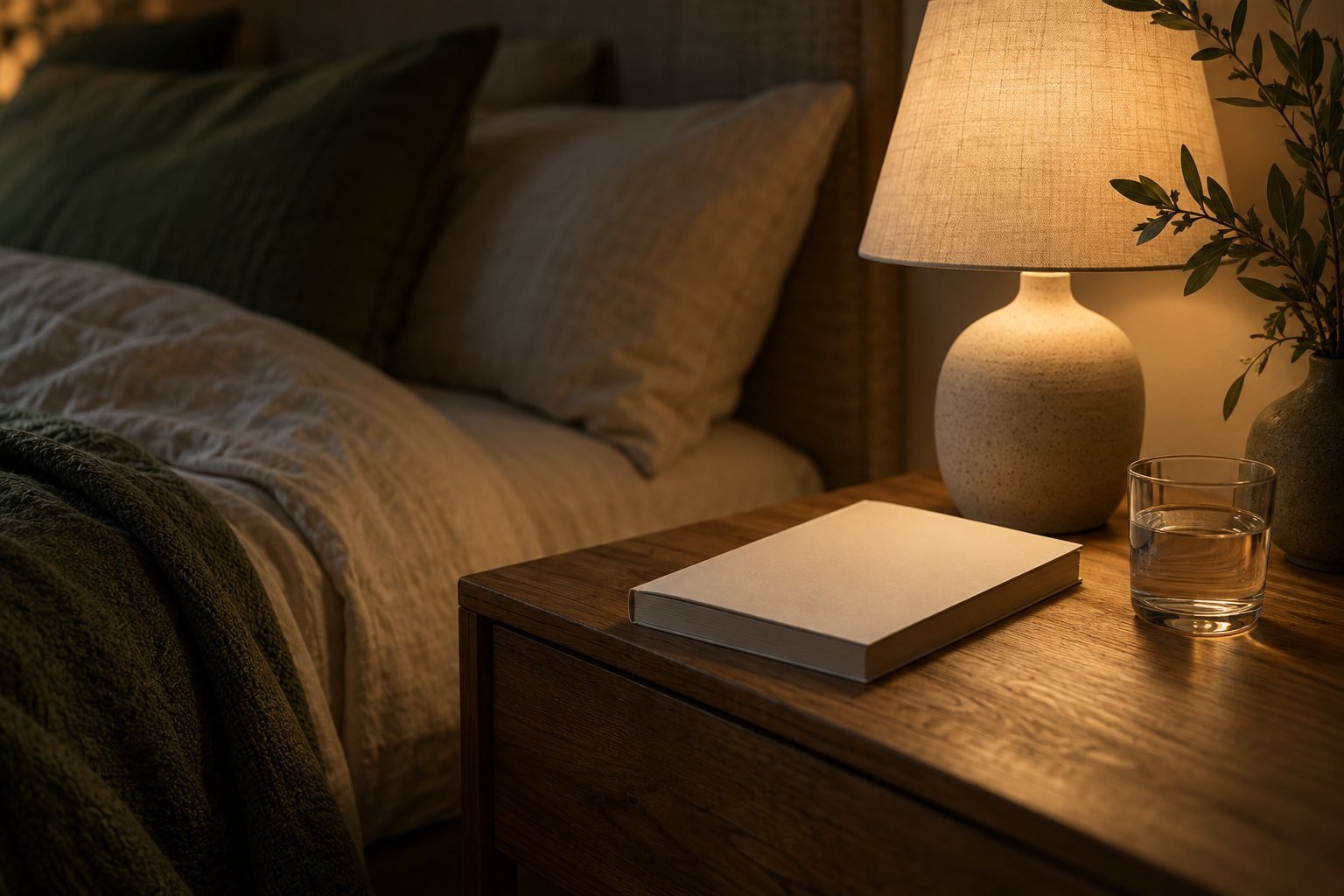
Go to bed later, not earlier
If you’re lying awake for forty minutes every night, the most common reason is simply that you’re getting into bed before you’re sleepy. The instinct after a bad night is to go up earlier to make up for it, which produces more time awake in bed and strengthens the association you’re trying to break.
How to do it
- Keep your wake-up time fixed, and push your bedtime later by twenty or thirty minutes.
- Go to bed when you’re sleepy, not when the clock says it’s bedtime. Sleepy means heavy eyes, not just tired.
- Hold it for a week. If you’re falling asleep quickly, move bedtime back earlier in fifteen-minute steps.
- Resist the urge to catch up after a bad night. One short night is far less costly than a week of lying awake.
- Keep the wake-up time through all of it. It’s the anchor the rest hangs on.
How much sleep to aim for
| Age | CDC recommendation |
|---|---|
| 18 to 60 | 7 or more hours |
| 61 to 64 | 7 to 9 hours |
| 65 and older | 7 to 8 hours |
Those are the CDC’s figures. Note that they describe sleep, not time in bed. Nine hours in bed to get six hours of sleep is the pattern this step is designed to break.

Set the caffeine cutoff earlier than feels necessary
This is the cheapest fix available and the one most people underestimate, because the effect is invisible: you don’t feel wired at eleven, you just take longer to drop off and sleep more lightly.
How to do it
- Work back eight hours from your bedtime and make that your cutoff. Six is the measured floor; eight gives you room.
- Count every source: tea, cola, energy drinks, pre-workout supplements.
- Move the dose earlier rather than cutting the total, if you don’t want to give anything up.
- Keep the ritual if that’s what you’ll miss — same mug, same moment, decaf or herbal.
- Give it a week before judging. The benefit arrives through better nights, not immediately.
What else is still circulating at bedtime
| Input | Effect on falling asleep |
|---|---|
| Alcohol | Speeds it up, then wrecks the second half of the night |
| A large late meal | Discomfort and reflux; aim to finish two to three hours before |
| Hard evening exercise | Keeps some people wide awake; test it on yourself |
| Nicotine | A stimulant, often overlooked in this list |
The alcohol trap: because it genuinely shortens the time to fall asleep, it looks like the solution to this exact problem. It then fragments the second half of the night, so you wake unrefreshed and reach for the caffeine, which pushes the next evening further. It’s the tidiest vicious circle in sleep.
Dim and cool the last hour
Light and temperature are the two signals the system reads most strongly, and both are easy to get wrong in a modern evening: bright overhead lights until the moment you go up, in a bedroom kept at living-room temperature.
How to do it
- Switch the overheads off an hour before bed and use low warm lamps.
- Get the phone out of the last stretch, or at least off your face. The eReader study above is the reason.
- Cool the bedroom. Cooler than the rest of the house, with enough bedding that it’s pleasant.
- Make it dark: standby lights, the gap in the curtains, the charging phone.
- Keep the bathroom light dim for the last trip, which is the one everyone forgets.
The last hour, in order
| Time before bed | What happens |
|---|---|
| 60 minutes | Overheads off, lamps on, screens winding down |
| 45 minutes | Warm shower, if you’re using one |
| 20 minutes | Phone out of the bedroom, bedroom cool and dark |
| Last 15 | Something quiet and boring on paper |
The warm shower timing: a 2019 meta-analysis in Sleep Medicine Reviews found that a warm shower or bath one to two hours before bed, for as little as ten minutes, was associated with falling asleep faster. The point isn’t the warmth itself, it’s the temperature drop that follows it, which is why the timing matters more than the temperature.

Give the busy head somewhere else to go
A racing mind at bedtime is usually the day’s unprocessed admin arriving at the first quiet moment it’s had. The fix isn’t to try to think less, which doesn’t work; it’s to move the thinking earlier.
How to do it
- Keep a notebook by the bed and write down whatever arrives. Getting it onto paper stops the loop that repeats it so you don’t forget.
- Better still, do the brain dump an hour earlier, at the end of the working day, so it isn’t waiting for you.
- Write tomorrow’s three priorities before you stop working, not in bed.
- If worry is the content rather than admin, a slow breathing pattern gives your attention somewhere neutral to sit.
- Don’t problem-solve in bed. Note it, and deal with it tomorrow when you’re a more useful person.
What to do with different kinds of thoughts
| What’s in your head | Where it should go |
|---|---|
| Tasks and reminders | The notebook, immediately |
| Tomorrow’s plan | Written before you stopped working |
| Replaying a conversation | Breathing, or getting up for ten minutes |
| Genuine worry that keeps returning | Daytime, and possibly a professional |
A pattern that’s easy to remember: breathe in for four, hold for seven, out for eight, a few times. There’s no strong evidence it does anything physiological, and it doesn’t need any — it occupies attention gently, which is the actual job.

If you’re awake, get up
This is the rule people find hardest and it’s the one with the clearest logic. Lying in bed awake, frustrated, teaches your brain that the bed is a place where you lie awake being frustrated. Getting up protects the association.
How to do it
- If you’ve been awake roughly twenty minutes and you’re not drifting, get up.
- Go to another room. Keep the lights low and do something dull: read something undemanding on paper.
- No screens, no work, no snacking, no checking the time.
- Go back when you feel sleepy, not when you think you’ve waited long enough.
- Repeat if you need to. It feels like a disaster the first few nights and stops being one.
Why clock-watching makes it worse
| What you do | What it produces |
|---|---|
| Checking the time at 1am | Arithmetic about how little sleep is left |
| That arithmetic | Alertness, exactly when you don’t want it |
| Turning the clock away | Removes the input entirely |
The phone version of this: picking it up at 2am gives you light, content and the time all at once. If it’s charging in another room, the decision is already made. That’s half the reason my evening routine for better sleep puts the phone in the hall.
What the bed should and shouldn’t be for
Underneath all five steps there’s one principle doing most of the work: your brain learns what a place is for. If the bed is where you sleep and nothing else, lying down becomes a cue for sleep. If it’s also where you answer email, watch three episodes, scroll for an hour and lie awake worrying, the cue becomes ambiguous, and an ambiguous cue is a slow one.
That’s why getting up when you’re awake isn’t a punishment — it’s protecting the association. And it’s why the wind-down happens somewhere else: an armchair, the sofa, anywhere that isn’t the mattress. The sequence you want is simple. You do the quiet, dull, dim thing elsewhere, you notice you’re sleepy, and only then do you go to bed. The bed is the last step, not the waiting room.
It takes a couple of weeks for that to re-learn itself if it’s been muddled for years, which is worth knowing before you decide after three nights that it doesn’t work. The nights in between are the cost, and it’s a short one. Seasonal timing matters here too: if the dark months are when this falls apart for you, the adjustments in my post on winter sleep stack neatly with these.
When it’s more than a slow night
Trouble falling asleep that lasts a few weeks, happens most nights, and affects how you function during the day has a name and a treatment pathway. The first-line approach for chronic insomnia is a structured behavioural programme rather than medication, and it works well for most people who complete it. That’s a conversation with a doctor, not a tip from a list.
The same applies if your partner reports loud snoring with pauses, if you’re exhausted all day despite adequate time in bed, or if something specific — pain, a medication, a new symptom — appeared at the same time as the problem.
Questions people ask about how to fall asleep faster
How long should it take to fall asleep?
Fifteen to twenty minutes is typical and completely fine. Consistently under five can be a sign you’re short on sleep overall, and consistently over thirty is the point at which the steps above are worth doing properly.
Do breathing techniques work?
They give your attention something undemanding to do, which helps if the problem is a busy head. Treat them as a distraction that works rather than as a physiological switch, and don’t add effort — trying hard to relax is self-defeating.
Can I listen to a podcast or audiobook?
For many people it works, because it occupies the part of the mind that otherwise narrates. Pick something familiar and undramatic, set a sleep timer, and keep the device out of your hands.
Should I take melatonin?
It’s a question for a pharmacist or doctor rather than a blog, partly because availability and regulation differ by country and partly because timing and dose matter more than people assume. The steps above are free and come first.
Does reading in bed keep me awake?
Paper reading in dim light is the classic wind-down and suits most people. The study above compared exactly that with a light-emitting device and the printed book came out ahead on every measure.
What if my partner’s schedule is different?
Separate wind-downs help: the later one reads elsewhere and comes in quietly. Eye masks and earplugs are unglamorous and effective, and a cooler room suits most pairs better than a warm one.
Go to bed when you’re sleepy rather than when the clock says so, move the caffeine earlier, dim and cool the last hour, put the day’s loose ends on paper before you go up, and get out of bed when you’ve been awake too long. None of it is dramatic, and knowing how to fall asleep faster turns out to be mostly about removing the things that were keeping you up.